

Remote Mine Site Power: When Does a Hybrid System Make Sense?
A diesel generator may be sized for the busiest moment on a remote mine site, then spend most of the day supplying only a fraction of that load. It still burns fuel, needs servicing and depends on a reliable fuel supply, regardless of how much power is being used.
That doesn’t make diesel the wrong choice. It remains essential for heavy equipment, sudden peaks, backup power and many short-term projects. The real question is whether it needs to run continuously.
Where a site has a steady base load – such as communications, monitoring, accommodation or security infrastructure – solar and battery storage can take on much of the routine work. The generator remains available when demand rises or stored energy runs low, but its operating hours may be significantly reduced.
Whether that approach makes commercial sense depends on more than electricity consumption. Fuel logistics, servicing, site access, project duration and downtime all influence the decision.
This article explores when hybrid power is worth considering, how to assess whether it suits a particular site, and the factors that influence the choice between a skid-mounted, containerised or fixed installation.
These are also some of the practical questions Commodore Australia will be discussing at IMARC 2026, where visitors to Stand U21 can walk through a fully containerised off-grid power system designed for remote mining and industrial applications.
The issue is not always the generator: it is how often it runs
On many remote sites, diesel generation remains essential. It responds quickly when pumps start, workshop equipment comes online or demand rises unexpectedly. It also provides reliable backup when uninterrupted power matters.
The challenge comes when a generator sized for those occasional peaks runs continuously through long periods of much lower demand. A unit capable of supporting the site’s busiest hour may spend the rest of the day powering communications, lighting, security systems or other relatively modest loads.
Those lightly loaded hours still consume fuel, count towards service intervals and require ongoing maintenance. Where access is difficult, routine servicing or even minor faults can become expensive interruptions.
This is where a hybrid system can change the way the generator is used. Solar and battery storage can supply much of the site’s routine demand, while the generator starts when higher loads or battery charging require additional support.
Hybrid power does not eliminate diesel generation – it changes how it is used. By reducing unnecessary generator runtime, sites can lower fuel consumption, servicing requirements and the operational costs associated with running a generator continuously.
When hybrid power starts to make commercial sense
Reducing generator hours sounds worthwhile, but it does not automatically justify investing in solar and battery storage. The strongest case usually emerges when several operating conditions align.
A consistent base load is one of the clearest indicators. Communications, monitoring, refrigeration, accommodation and security equipment can create demand day and night, even when heavier machinery is not operating. These steady loads are often well suited to battery storage because they are predictable and consistent.
The project timeline also matters. A system supporting a multi-year operation has more time to recover its upfront investment than one deployed for a short exploration program. If a site may close or relocate within months, diesel generation may remain the more practical option unless the hybrid equipment can be redeployed.
Location can also influence the decision. The true cost of diesel extends beyond fuel consumption to include transport, storage, handling and the servicing required to keep generators operating in remote areas. Difficult access and long travel distances can significantly increase the cost of maintaining a generator-based power supply.
Load behaviour remains a critical factor. A site with a stable underlying demand and occasional peaks presents a different opportunity from one dominated by large, unpredictable equipment. In the first case, batteries can support routine consumption while the generator manages higher demand events. In the second, the scale and cost of a hybrid system may be harder to justify.
There is no single fuel price, generator runtime or project duration that determines whether hybrid power makes sense. The commercial case becomes clearer when actual load data, operating costs and the expected life of the site are considered together.
What this looked like at a Fortescue site
A remote Fortescue project in Western Australia demonstrates what can happen when a hybrid system is used to reduce unnecessary generator runtime.
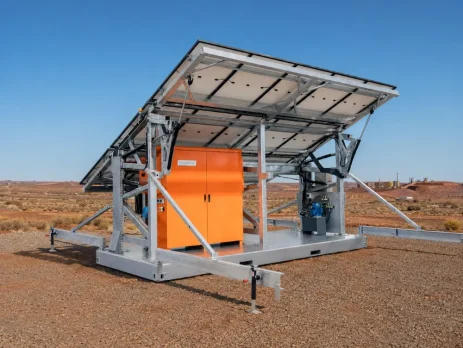
The site had previously relied on continuous diesel generation. Commodore Australia supplied a Rhino Bolt hybrid solar power skid, integrating solar generation, battery storage and generator backup into a transportable system designed for remote operation.
During normal operation, solar and batteries supplied the site’s regular load, while the generator remained available when additional capacity or charging was required.
The results demonstrate the potential of matching the power system to the way a site actually operates. Published outcomes from the project included:
- A 95% reduction in generator runtime
- 22 tonnes of CO₂ emissions avoided annually
- Break-even achieved within the first year
The results from this project are specific to the site and should not be treated as a standard outcome for every remote operation. The broader lesson is that hybrid power works best when the system is designed around the site’s actual load, operating conditions and project requirements.
Skid, container or fixed installation?
Once hybrid power appears commercially viable, the next decision is determining how the system should be deployed. The right format depends on the project timeline, power requirements, site access and whether the system needs to move.
For exploration programs, communications infrastructure and other applications where equipment may relocate with the project, a transportable power skid can provide a compact solution. Batteries, inverters, controls and generator integration can be assembled on a common platform, simplifying deployment when site requirements change.
Containerised systems suit larger power requirements or projects requiring a self-contained power station. They provide additional space for battery capacity, switchboards, controls and other equipment, while allowing the complete system to be transported between locations when required.
A fixed hybrid installation may be more suitable for permanent infrastructure where the load is well understood and there is no need for regular relocation. This approach provides greater flexibility for equipment layout, solar array design and future expansion.
The choice should follow the site plan, not the other way around. A compact skid may suit a smaller continuous load but become restrictive as demand grows. A containerised system may provide greater capacity, but access, transport requirements and deployment conditions must also be considered. Where suitable generator infrastructure already exists, it may also be possible to integrate hybrid components rather than replace the existing system.
Selecting the right format starts with understanding how the site operates today, how requirements may change over the project life and what level of flexibility is required.
Start with how the site actually uses power
Before comparing equipment or estimating potential savings, the first step is understanding how the site uses power today. A daily energy consumption figure provides useful information, but it does not show when demand occurs, how high peak loads reach or what happens when multiple pieces of equipment operate at the same time.
For an operating site, interval load data can reveal the base load carried through the day and night. Generator records, fuel consumption and service history can provide further insight into the current cost of power generation and where operating efficiencies may be gained. For new projects, equipment specifications, operating schedules and motor starting requirements can help build an initial load profile.
Peak demand requires particular attention. Pumps, compressors and workshop machinery can draw significantly more power during startup than during normal operation. The assessment should identify which equipment may run simultaneously, whether single-phase or three-phase power is required and which loads are critical to site operations.
The project timeline and operating environment also influence the right solution. A system supporting a long-term operation may justify a different approach to one deployed for a short exploration program. Future expansion, relocation requirements, access constraints, heat, dust and moisture exposure all need to be considered during system design.
With a clear understanding of the site’s requirements, generator-only and hybrid options can be compared on a whole-of-life basis. Fuel, servicing, site attendance, downtime and future operating needs should all be considered alongside the initial equipment investment.
Is hybrid power the right fit for the site?
Hybrid power is not automatically the right choice for every remote operation. Generator-only power may remain the most practical option for short-term projects, unpredictable loads or sites where equipment demand changes significantly.
The case for hybrid power becomes stronger when a site has a consistent base load, the generator operates for long periods and fuel logistics, servicing or site access create significant operating costs. In these situations, solar and battery storage can support routine demand while diesel remains available for peaks and backup.
The starting point is not selecting a battery size, skid or container. It is understanding how the site uses power, what it costs to maintain that supply and how those requirements may change throughout the project.
These are the practical considerations Commodore Australia will be discussing at IMARC from 27 to 29 October, 2026. Visit Stand U21 at ICC Sydney to walk-through a fully containerised off-grid power system and discuss your remote mining or industrial power requirements with the Commodore team.


