

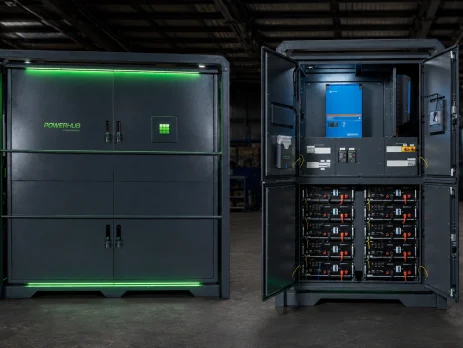
Introducing the New Generation of Power Hubs
A Smarter, More Capable Off-Grid System for Larger Applications
The Power Hub has evolved. Commodore’s new generation of Power Hubs introduces a completely redesigned cabinet engineered to meet the demands of larger, more energy-intensive off-grid applications.
More than a cosmetic update, the new design brings together increased battery capacity, advanced temperature management, smarter monitoring and improved serviceability in a cabinet built for demanding Australian conditions. From larger rural homes and farms to commercial and industrial sites, the new Power Hub range is designed to deliver greater capability, flexibility and confidence for the years ahead.
The new generation includes the Power Hub 15 XL, Power Hub 20 Commercial, Power Hub 30 Commercial, Power Hub 45 Commercial and Power Hub 60 Commercial – giving customers more options to match their energy requirements, from large off-grid homes through to heavy-duty commercial applications.
Completely Redesigned
At the heart of the new generation is a completely redesigned Power Hub cabinet. Purpose-built for larger off-grid systems, the new design brings greater battery capacity together with a more practical, refined approach to equipment layout, access and system management.
The redesigned cabinet is built around the realities of owning and operating an off-grid system. Improved service access, practical cable entry points, clearer internal organisation, and enhanced security make the system easier to install, maintain and manage, while optional external framing and integrated lifting points provide greater flexibility for transport, installation and future expansion.
The result is more than a new look. Every aspect of the cabinet has been considered to make the Power Hub a more capable, practical and future-ready solution for larger off-grid applications.
Built for Australian Conditions
Off-grid systems are often installed in some of Australia’s most demanding environments, from remote rural properties and farms to exposed regional locations. The new Power Hub cabinet has been engineered to help protect critical electrical equipment and support reliable performance in real-world conditions.
With IP55-rated, dust-protected, weather-resistant and rodent-proof construction, the cabinet combines robust double-wall construction and insulation with standard DC air conditioning to help maintain a stable internal environment in hot conditions. For alpine applications, optional low-wattage, temperature-controlled heating is available to help protect battery performance in colder climates.
From extreme heat to cold climates, the new Power Hub cabinet is designed to help protect the equipment inside and deliver reliable performance wherever dependable energy is required.
Increased Capacity, Greater Performance
As off-grid energy needs grow, having more stored energy and greater system capability can make all the difference. The new Power Hub range has been designed to support larger loads, greater energy storage and the flexibility to accommodate changing energy requirements over time.
The Power Hub 15 XL can accommodate up to 10 batteries, while the new Commercial cabinets can accommodate up to 15 batteries. This increased capacity provides more stored energy for larger homes, farms, workshops, commercial sites and other high-demand applications, while creating greater scope for future expansion.
The new generation also uses a Victron transformer-based inverter platform, selected for its ability to handle demanding off-grid loads and high start-up surges. Combined with advanced temperature management and a modular system architecture, the result is a Power Hub designed to deliver dependable performance when energy demands are high.
Smarter Monitoring – Visibility At-a-Glance
Knowing how your off-grid system is performing shouldn’t require opening the cabinet or being on site. The Power Hubs make system status easier to see, while giving customers and service teams greater visibility over performance.
External LED lighting gives the new cabinets a distinctive visual identity, while the LED status ring provides an at-a-glance indication of battery state of charge and whether the system is charging or discharging. An external monitoring access lid also provides convenient access to key system information without opening the main cabinet.
Inside, Victron Cerbo GX provides a central monitoring and communications hub, with Victron VRM enabling remote visibility of system performance. Depending on the system configuration, this can include battery state of charge, solar production, energy consumption, inverter activity, generator operation, alarms and historical performance.
For customers with systems in rural or remote locations, smarter monitoring means greater confidence and can also help make troubleshooting and ongoing support simpler and more efficient.
Designed for Easier Installation and Service
A better-designed Power Hub isn’t just easier to use – it’s easier for installers and technicians to work with. The new cabinet has been designed to improve access, organisation and serviceability throughout the installation and ownership journey.
A modular internal architecture separates key system functions into individual components, supporting clearer layouts, easier servicing and component-level replacement when required. AC/DC separation, practical cable entry points and improved access to key equipment help create a cleaner installation and a more efficient service workflow.
For larger systems, an optional external frame with integrated lifting points makes transport and positioning more practical, particularly on remote or difficult-access sites. Enhanced locking and security features provide additional protection, while the cabinet has been designed with flexibility for future additions and accessories.
The result is a system that’s not only engineered to perform, but designed to make installation, servicing and future upgrades more straightforward.
Built in Shepparton. Rigorously Tested.
The new Power Hubs are assembled in Commodore’s Shepparton workshop, where skilled production teams build and prepare each system under controlled workshop conditions. Keeping the build process in-house allows Commodore to maintain close oversight of assembly, quality and testing before each Power Hub heads to site.
Every system goes through a structured quality control and testing process, including load testing, thermal imaging inspection and 195 individual quality checks. These checks are designed to identify issues before dispatch and ensure each system is ready for installation and operation.
Commodore’s ISO-certified management systems support documented processes, consistent build standards and repeatable quality control across production. Together, these processes provide another layer of confidence that the new generation of Power Hubs is built, checked and prepared to the standards required for demanding off-grid applications.
Five Power Hubs. Built for Different Applications.
The new generation brings the redesigned Power Hub cabinet to a range of system sizes and applications, from larger off-grid homes through to demanding commercial and industrial sites.
Designed for larger rural homes, lifestyle properties and off-grid applications requiring greater battery capacity.
Built for larger homes, farms and high-demand off-grid applications, with greater capacity and flexibility for future energy needs.
Designed for larger three-phase homes, workshops and other high-demand applications.
A high-capacity three-phase solution for extra-large homes, workshops and demanding off-grid applications.
Built for serious energy demands across commercial, agricultural and heavy industrial applications, where robust three-phase power and high system capacity are essential.
Together, the range provides a scalable pathway for customers whose energy needs extend beyond entry-level off-grid systems — with the capability to support larger loads, greater storage requirements and future growth.
A New Generation of Power Hubs
The new generation of Power Hubs represents a major evolution in how larger off-grid systems are designed, built and supported. From the redesigned cabinet and increased battery capacity to smarter monitoring, advanced temperature management and improved serviceability, every element has been considered to make the Power Hub more capable and easier to own.
Built in Shepparton, tested before it leaves the workshop and engineered for demanding Australian conditions, the new range is designed to deliver dependable performance today while providing the flexibility to adapt as energy needs change.
The Power Hub, redesigned. Built for what’s next.


