Case Study: Hybrid Off-Grid Power Skids Support Autonomous Drone Operations Across Two Remote WA Mining Sites
Supporting next-generation site monitoring with reliable, transportable off-grid power
Autonomous drone systems are becoming a valuable tool for remote mining operations. They help teams improve visibility, collect site data, monitor assets, and reduce manual inspections in difficult or high-traffic areas.
However, advanced drone technology still depends on one simple thing: reliable power.
For a remote mining operation in Western Australia, Commodore Australia designed and manufactured two self-contained hybrid off-grid power skids to support autonomous drone operations and associated site monitoring infrastructure across two separate sites.
The project involved the delivery of two custom Rhino Wind Region B Skids, each designed to support a drone dock system, recharge cycles, surveillance equipment, weather monitoring, networking hardware, and environmental control infrastructure in remote operating environments where grid power was not available.
Rather than relying on generator-only power, Each skid combines solar generation, lithium battery storage, Victron power conversion equipment, and diesel generator backup into a single transportable platform.
The challenge: powering critical technology across remote mining locations
The project required reliable temporary power supplies for autonomous drone infrastructure operating across two remote mining sites in Western Australia.
Each system needed to support:
- Autonomous drone flights and recharge cycles
- Drone dock operation
- Surveillance and monitoring equipment
- Weather monitoring infrastructure
- Communications and networking hardware
- Environmental control equipment
- Backup power during periods of low solar generation
A generator-only approach could have supplied the required power, but it would have increased fuel consumption, servicing requirements, maintenance demands, and dependence on site attendance.
In remote mining applications, the cost of diesel generation goes well beyond the fuel itself. Fuel delivery, generator servicing, dust, heat, access constraints, technician callouts, and downtime risk can all add to the operational burden.
As a result, the mining operation needed a more efficient and resilient power solution for multiple locations, without compromising the availability of the drone infrastructure.
The solution: two Rhino Wind Region B hybrid power skids
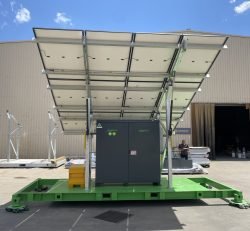
Commodore Australia designed and manufactured two custom Rhino Wind Region B Skids for the application.
Each skid combines:
- Solar generation
- Integrated Power Hub cabinet with Victron power conversion equipment
- Pylontech Lithium battery storage
- Backup diesel generator
- Structural solar canopy
- Heavy-duty skid base
- Integrated safety equipment
- Serviceable layout with access to key components
- Pre-wired and tested system architecture
Commodore Australia built and tested the systems at its facility in Shepparton, Victoria, before preparing them for deployment to two remote sites in Western Australia.
By integrating the solar array, battery storage, inverter system, generator backup, and supporting infrastructure onto a single skid base, each system reduced the need for separate mounting structures or major civil works.
This made the solution well suited to remote mining applications where speed, transportability, and practical site deployment were all important considerations.


How the hybrid skids work
Each skid prioritises solar energy during the day. The solar array supplies power to the connected loads and charges the battery system.
Then, the battery supports overnight loads, drone recharge cycles, and periods of reduced solar production.
The backup generator adds another layer of reliability. It can support the system during long periods of poor weather, seasonal low-solar conditions, or higher-than-expected energy demand.
This hybrid approach helps each skid reduce generator runtime while maintaining reliable power for critical remote infrastructure.
Why hybrid power was the right fit
Autonomous drone systems require more than occasional power during flight operations.
The dock and supporting infrastructure need to remain available so the drone can recharge, redeploy, communicate with operators, receive mission instructions, and operate safely within the site environment.
A solar-only system could introduce risk during poor weather or winter conditions. A generator-only system would increase fuel use, servicing requirements, noise, emissions, and operational costs.
The hybrid design provided the right balance between efficiency and reliability.
Key benefits included:
- Reduced generator runtime
- Lower fuel consumption
- Reduced maintenance requirements
- Improved power resilience
- Lower operating costs
- Reduced emissions
- Faster deployment compared with more permanent infrastructure
- A repeatable power platform for multiple remote sites
- Ability to support critical remote loads without grid access
In remote mining, the real cost of diesel generation goes beyond the fuel itself. It can also include delivery, servicing, technician callouts, downtime risk, and the ongoing task of keeping generators running in isolated locations.
Supporting autonomous drone operations
The two hybrid skids were designed to support autonomous drone operations across two separate remote sites.
Each system supports the drone dock, recharge cycles, and the supporting equipment required to keep the platform operational, including surveillance, weather monitoring, networking, and environmental control infrastructure.
This is a critical distinction. The power systems were not simply designed to charge drones. They were designed to support the complete operating environment that allows autonomous drone technology to function reliably in remote industrial settings.
By providing continuous power availability at each site, the hybrid skids help enable repeatable drone missions, remote monitoring, and improved operational visibility without relying on manual generator management.
Built for practical deployment
The completed skids show the advantage of integrating all major components into one transportable platform.
Each structural solar canopy is mounted directly to the skid frame, while the battery and inverter cabinet, generator backup, and safety equipment are positioned for practical access and servicing.
The heavy-duty base frame also supports transport and handling, helping simplify movement and deployment in remote site environments.
This type of design is particularly useful for temporary, semi-permanent, or evolving mining infrastructure, where requirements can change and equipment may need to be relocated in the future.
Rather than treating power as a collection of separate components, the systems were delivered as complete platforms designed around the realities of remote operation.
Performance modelling and expected savings
Performance modelling showed that the hybrid systems could offset generator usage almost entirely during summer and shoulder seasons, with only minimal generator runtime required during winter’s lowest solar conditions.
Based on project modelling, the two-skid deployment is expected to deliver:
- Payback period of under three years
- Annual return on investment exceeding 36%
- Projected 15-year savings approaching $500,000
- Significant reduction in generator runtime
- Lower fuel consumption
- Reduced servicing and maintenance requirements
- Improved reliability for critical monitoring infrastructure
The result is a more efficient way to power remote technology while reducing the operational and financial burden associated with continuous diesel generator use.
Manufactured in Australia for remote Australian conditions
The systems were manufactured by Commodore Australia in Shepparton, Victoria, reflecting the company’s focus on Australian-built off-grid and hybrid power solutions for remote, industrial, mining, agricultural, and infrastructure applications.
For this project, the value of local manufacturing was not only in the physical build. It was also in the ability to design, integrate, pre-wire, and test the systems before deployment.
That approach helps reduce site variables, simplify commissioning, and improve confidence before the systems reach remote operating environments.
The result: reliable power for the next generation of mine site technology
This project demonstrates how hybrid off-grid power can support the next generation of remote mining technology.
By replacing continuous generator operation with two solar-battery-generator hybrid skids, the mining operation gained a more efficient and resilient power supply for autonomous drone operations and associated monitoring infrastructure across two separate sites.
The systems reduced reliance on diesel generation while improving power availability, lowering long-term operating costs, and supporting critical remote equipment in demanding environments.
As mining operations continue to adopt autonomous systems, remote monitoring, and data-driven site management, reliable off-grid power will become an increasingly important part of the infrastructure that enables these technologies.
For Commodore Australia, the project highlights a practical application of hybrid power in the field: not as a generic renewable energy add-on, but as a purpose-built platform designed to keep critical remote systems operating reliably.
Need reliable power for remote mining, monitoring or critical site infrastructure? Speak with our commercial off-grid team.