

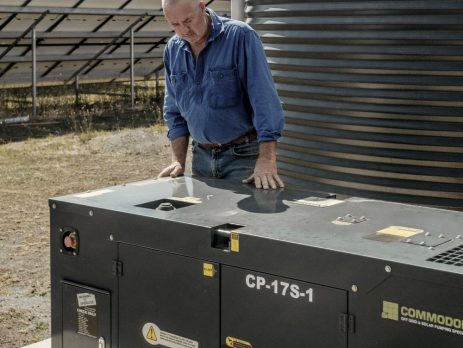
Can You Keep Your Existing Generator With a New Off-Grid Solar System?
In many cases, you can keep an existing generator with off-grid solar, but Commodore needs to assess it before confirming compatibility. Its continuous output, phase, voltage and frequency stability, control method, condition and electrical installation all affect whether it can support the new inverter and battery system reliably.
If the generator is suitable, it can remain as a backup source that supports property loads and helps the inverter-charger recharge the batteries during extended poor weather or unusually high demand. If it is not suitable, Commodore can explain whether a control upgrade, manual arrangement or replacement generator offers the better option.
Already have a generator? Send Commodore its make and model, a clear photo of the nameplate and control panel, its phase and rated output, and any available service information. Our team can assess it as part of your complete off-grid system design.
Key points
- You may be able to retain your existing petrol or diesel generator, but Commodore must assess it first.
- A generator’s kVA rating alone does not confirm compatibility.
- Two-wire auto-start offers the simplest path to fully automatic operation, but other control arrangements may sometimes work.
- A manual-start generator may still provide backup, although it cannot start itself when the property is unattended.
- Generator servicing, mechanical faults and generator-specific warranty work normally remain with the generator supplier or service agent unless otherwise agreed.
What role does a generator play in an off-grid solar system?
A modern off-grid solar system combines solar panels, battery storage, an inverter-charger and a backup strategy. Solar supplies energy when it is available, while the batteries store energy for use at night and during periods of low production.
The generator provides another source of energy when poor weather continues, demand rises above normal or the system reaches another programmed operating condition. When the inverter-charger accepts the generator supply, it can use that energy to support property loads and recharge the battery bank according to the approved settings.
This changes the generator’s role. Instead of running as the property’s main source of electricity, it becomes a planned backup within a complete power system.
However, a generator does not correct an undersized solar array, inadequate battery storage or an inverter that cannot support the property’s loads. Reliable off-grid power still starts with a detailed load assessment and a system designed for the property, its location and its seasonal energy use. Learn more about the common causes of off-grid solar reliability problems
Can I keep my existing generator?
In many cases, yes. You do not necessarily need to replace a generator simply because it is older or previously supplied all the property’s power.
The key question is whether it can perform its new role reliably. It needs to deliver suitable, stable power, provide enough continuous capacity for the intended loads and battery charging, and connect safely within the new system design.
Commodore cannot confirm that from the advertised generator size alone. Two generators with a similar kVA rating can have different duty ratings, voltage regulation, controllers, phase arrangements and operating condition.
This is why Commodore reviews each existing generator before including it in a design. The assessment may lead to one of four outcomes:
- Retain the generator with automatic start and stop.
- Retain it with an approved interface or control modification.
- Retain it as manual backup.
- Replace it with a generator better suited to the new system.
What does Commodore check?
Commodore will normally ask for the generator details early in the design process. This helps prevent a customer from making plans around equipment that cannot perform the intended role.
| What we check | Why it matters |
|---|---|
| Make, model and age | These details help identify the alternator, controller, duty rating, documentation and available control interfaces. |
| Continuous output | The generator must support the planned combination of property loads and battery charging without sustained overload. Its continuous rating matters more than a short peak rating. |
| Single-phase or three-phase output | The phase arrangement must suit the new system’s electrical architecture. Three-phase systems require particular care. |
| Voltage and frequency stability | The inverter-charger must accept and synchronise with the generator supply. Unstable output can cause repeated connection and disconnection. |
| Power quality and regulation | Poor waveform or regulation may prevent reliable charging or cause the inverter-charger to reject the input. |
| Start and stop controls | The available controls determine whether the generator can operate automatically or requires manual starting. |
| Duty rating and cooling | The generator must suit the expected operating duration and load. Cooling method alone does not decide suitability. |
| Mechanical condition | A difficult-to-start, poorly maintained or unreliable generator will not make a dependable backup source. |
| Protection, neutral and earthing arrangement | A licensed electrician must confirm that the proposed arrangement can meet the applicable electrical and manufacturer requirements. |
| Connection method | The approved method depends on the generator, the off-grid equipment and the complete installation design. |
Victron Energy notes that generator power is generally more variable than mains power. An inverter-charger can apply configured input limits and settings, but the generator still needs to maintain suitable voltage and frequency while carrying the required load.
Does my generator need two-wire auto-start?
Not always, but Commodore strongly prefers two-wire auto-start when a customer wants automatic backup.
With two-wire control, the off-grid control system uses a relay contact to request a start or stop. The system can then call for the generator when programmed conditions occur and stop it when those conditions clear. The actual settings depend on the system design and may consider more than battery state of charge alone.
Some generators use three-wire or pulsed start and stop controls. These may still work with a suitable controller or additional relays, but Commodore needs to inspect the generator controller before confirming the available functions. Victron documents relay-controlled generator operation and arrangements for three-wire interfaces.
Two-wire control therefore offers the simplest option, but the absence of a standard two-wire input does not automatically make a generator unusable.
Can I use a manual-start generator?
A manual-start generator may work if its electrical output and connection arrangement suit the new system. Once someone starts it, the inverter-charger may accept the incoming supply, support loads and charge the batteries as configured.
The main limitation is straightforward: the generator cannot start itself.
If the batteries run low overnight, poor weather continues or nobody is at the property, a manual generator cannot provide unattended backup. Someone needs to respond, start it and stop it when required.
Manual operation may suit an occupied property where the owner feels comfortable managing the generator. It is usually less suitable for an unattended site, critical loads or anyone seeking fully automatic operation.
A manual-start generator does not necessarily prevent all system monitoring. The off-grid system may still record AC input and charging behaviour after the generator starts. However, Commodore cannot remotely start a generator without a suitable remote-start interface, and the generator-specific information available will depend on its controller and communications.
How large does the generator need to be?
There is no reliable generator-to-inverter ratio that suits every property. Commodore considers:
- the generator’s continuous output;
- the battery-charging demand;
- the property loads likely to run at the same time;
- starting demand from pumps, compressors and other motors;
- single-phase or three-phase operation;
- the inverter-charger’s approved AC input settings; and
- the generator’s ability to maintain stable output as loads change.
A generator that is too small may overload, struggle as loads change or produce voltage and frequency conditions that the inverter-charger will not accept. However, generator size does not always need to equal the inverter’s full capacity. Some inverter-chargers can limit the power drawn from an AC source and support short demand peaks within the approved design.
That flexibility does not make any small generator suitable. It means Commodore needs to assess the generator alongside the charging requirements and the property’s actual load profile instead of relying on one equipment rating.
If you have not completed a load profile, the Commodore off-grid calculator provides a useful starting point.
What could make an existing generator unsuitable?
Commodore may advise against retaining a generator if it has one or more of the following problems:
- insufficient continuous capacity for the planned loads and charging demand;
- the wrong phase arrangement for the new system;
- unstable voltage or frequency as loads change;
- power quality that the inverter-charger cannot reliably accept;
- an unsuitable duty rating for the expected operating pattern;
- an incompatible or impractical start and stop controller;
- unreliable starting, poor condition or an incomplete service history;
- a protection, neutral or earthing arrangement that cannot form part of a compliant installation;
- no practical way to achieve automatic backup where the property requires it; or
- a design intended for occasional portable use rather than the proposed backup role.
Age alone does not decide suitability. A well-maintained older generator may work, while a newer generator may still prove unsuitable if its output, controls or installation do not match the new system.
What about portable generators?
A portable generator may be useful for tools, occasional appliance use or emergency power, but that does not automatically make it suitable for integration with a permanent off-grid system.
The assessment needs to consider its output quality, continuous duty, controls, electrical protection, connection method and intended operating pattern. Some portable generators will not suit automatic battery charging or permanent integration. Others may serve a limited manual-backup role if the complete arrangement meets the design and installation requirements.
Do not modify a generator or property wiring yourself. A licensed electrician must assess and install the relevant connection, switching, protection, neutral and earthing arrangement.
Is a water-cooled generator better than an air-cooled generator?
Neither cooling method answers the compatibility question on its own.
Manufacturers often design water-cooled generators for longer or more demanding operation. Some air-cooled models suit lighter or intermittent backup duties. However, the specific model, continuous rating, expected run profile, ambient conditions and servicing requirements matter more than a general label.
Commodore will assess how the generator is expected to operate within the completed system. If your existing model cannot handle that duty reliably, replacement may offer better long-term value than trying to retain it.
What happens if my generator is not compatible?
An unsuitable generator does not always mean immediate replacement. The available options depend on the reason it failed the assessment.
Add an approved control interface
Some electric-start generators may support an appropriate controller or relay arrangement. This depends on the engine, starter, stop system, existing controller and manufacturer documentation. Commodore or the relevant qualified technician must confirm whether a modification is practical.
Keep it for manual backup
If the generator produces suitable power but cannot accept an automatic start command, it may still serve as manual backup. This option only makes sense when someone can respond and the system design allows manual operation.
Replace the generator
Replacement may provide the best outcome when the generator is undersized, unreliable, unsuitable for the expected duty, difficult to integrate or expensive to modify.
Commodore supplies off-grid backup generators with options designed for integration with solar and battery systems. The correct model still depends on the property’s loads and the complete system design.
What information should I send Commodore?
You can speed up the assessment by providing:
- the generator make and exact model;
- a clear photo of the nameplate;
- a clear photo of the control panel and connection points;
- continuous and standby ratings, if shown;
- single-phase or three-phase output;
- fuel type;
- electric, manual or remote-start details;
- controller make and model, if fitted;
- approximate age and operating hours;
- service history and any known faults;
- details of how it currently supplies the property; and
- information about major loads such as pumps, refrigeration, air conditioning or workshop equipment.
Do not worry if you cannot answer every technical question. Clear photos and the exact model number give the team a useful place to start.
Who is responsible for the existing generator after integration?
Where Commodore approves an existing third-party generator, we can design and configure the new off-grid system around the approved interface.
Unless otherwise agreed in writing, servicing, mechanical faults, manufacturer warranty and generator-specific repairs remain the responsibility of the generator owner, manufacturer, supplier or service agent. Commodore’s assessment confirms suitability for the proposed integration. It does not transfer responsibility for the condition or future mechanical reliability of third-party equipment.
Electrical installation and compliance
Generator integration forms part of the electrical design of the stand-alone power system. A licensed electrician must assess and install the relevant connection, switching, protection, neutral and earthing arrangement in accordance with the applicable Australian standards, manufacturer instructions and state or territory requirements.
The correct arrangement depends on the equipment and the site. For that reason, this article does not provide DIY wiring instructions or a universal connection method.
Keep useful equipment, where it makes sense
An existing generator can remain a useful part of a new off-grid solar system, but only when it suits the job. The best outcome comes from assessing it early, before Commodore finalises the solar, battery, inverter and backup strategy.
If the generator is compatible, retaining it may reduce unnecessary replacement and preserve a reliable backup source. If it is not compatible, you will know why and can compare a control change, manual arrangement or replacement on practical terms.
Commodore has specialised in off-grid power since 2011. Our Power Hub systems combine the inverter, battery storage, controls and protection within a complete off-grid solution, with generator integration considered as part of the property-specific design.
Want to know whether your generator can stay? Send Commodore the generator details listed above when you enquire about your off-grid system. Our team can assess it as part of the complete design.
Frequently asked questions
Can I keep my existing generator when installing off-grid solar?
In many cases, yes. Commodore first needs to assess the generator’s make, model, continuous output, phase, power quality, controls, condition and proposed connection. Its kVA rating alone cannot confirm compatibility.
Does my generator need two-wire auto-start?
Not necessarily, but two-wire control usually provides the simplest option for automatic generator start and stop. Some other control methods may work with compatible controllers or additional relays. Commodore assesses this case by case.
Can I use a manually started generator?
Potentially. If the generator and connection arrangement are suitable, it can support the system after someone starts it. However, it cannot provide unattended automatic backup, so someone must remain available to start and stop it.
Can my existing generator charge the new batteries?
The generator normally supplies AC power to the inverter-charger, which charges the battery bank according to the approved system settings. Whether an existing generator can perform this role reliably depends on its capacity, stability, duty rating and compatibility with the inverter-charger.
How large does my generator need to be?
There is no universal generator-to-inverter ratio. The design needs to account for continuous output, battery-charging demand, loads running at the same time, motor starting, phase and the inverter-charger’s configured input limits.
Can I retain a portable generator?
Possibly, but many portable generators suit intermittent appliance or tool use rather than permanent integration and automatic battery charging. Commodore and the installing electrician need to assess the model, connection method, protection and intended duty before confirming suitability.
Can I keep an older generator?
Age alone does not rule it out. Its electrical performance, condition, reliability, duty rating, controller and service history matter more. Commodore needs to assess these factors before approving it.
Will Commodore monitor my existing generator?
The available monitoring depends on the generator controller, communications and system configuration. Commodore may be able to monitor aspects of generator operation through the off-grid system, but we cannot confirm the available functions until we assess the generator.
Who services the generator after integration?
Unless otherwise agreed, servicing, mechanical faults and generator-specific warranty work remain with the generator manufacturer, supplier or service agent. Commodore assesses and integrates approved equipment with the new off-grid system.
Will my generator run less after I install off-grid solar?
It often should because solar and batteries become the primary energy sources and the generator becomes backup. Actual run time still depends on your energy use, seasonal solar production, system size, settings, weather and generator condition.


